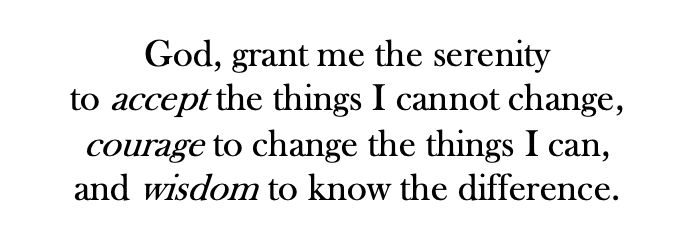
Acceptance, Courage & Wisdom
Some people change.
Some people… talk about changing.
I see it every day.
Some clients take this work and run with it. They practice between sessions, stay engaged, and become powerful communicators.
In contrast, some clients only think about the work when I’m right in front of them. They don’t do the homework, don’t take the work we are doing together into every conversation they have, and see only minor results.
Same intelligence, same access, but completely different results. This difference has nothing to do with talent, so what is it? What allows someone to actually follow through on what they say they want for themselves?
Whether it’s losing weight, getting stronger, learning a new skill, getting out of debt, building savings, growing investments, clearing clutter, or creating a more balanced life—it’s not magic.
It comes down to where you believe control lives.

LOCUS OF CONTROL
“Locus” means place. As in, where is the steering wheel of your life?
An external locus of control says the wheel is outside of you.
You call it luck, timing, other people, circumstances, as if life is happening to you.
“It just wasn’t my day.”
“I got lucky.”
“There’s nothing I can really do about it.”
Live here long enough, and you start to feel powerless, less confident, and more passive. At the extreme, you stop trying.
Yet, there’s a hidden strength here. People with a more external orientation are often better at accepting reality. They don’t exhaust themselves trying to control the uncontrollable. They don’t carry unnecessary guilt for things that were never theirs to own.
Now swing the other way.

An internal locus of control says the wheel is in your hands. Your actions, choices, and effort matter.
“What could I have done differently?”
“I need to adjust my approach.”
“My preparation matters.”
This creates movement, ownership, and resilience. It’s the engine behind growth.
Yet, it has a shadow component.
Taken too far, it becomes heavy. You start believing you should be able to control everything—markets, timing, other people’s reactions. That pressure turns into burnout, self-blame, and a constant low-grade tension.
So which one is right? Neither.

The people who actually change, the ones who follow through—don’t live at either extreme. They operate from a bi-locus of control.
They take full responsibility for what’s theirs: their effort, their preparation, their choices, their attitude. They release what isn’t: timing, systems, other people, randomness.
You act where you have agency.
You release where you don’t.
The people who grow don’t outsource their lives. They don’t wait to feel motivated. They don’t hand their worth to other people.
They don’t fight reality. They stay engaged with what’s theirs to do… and they let the rest go.
Acceptance
Courage
Wisdom