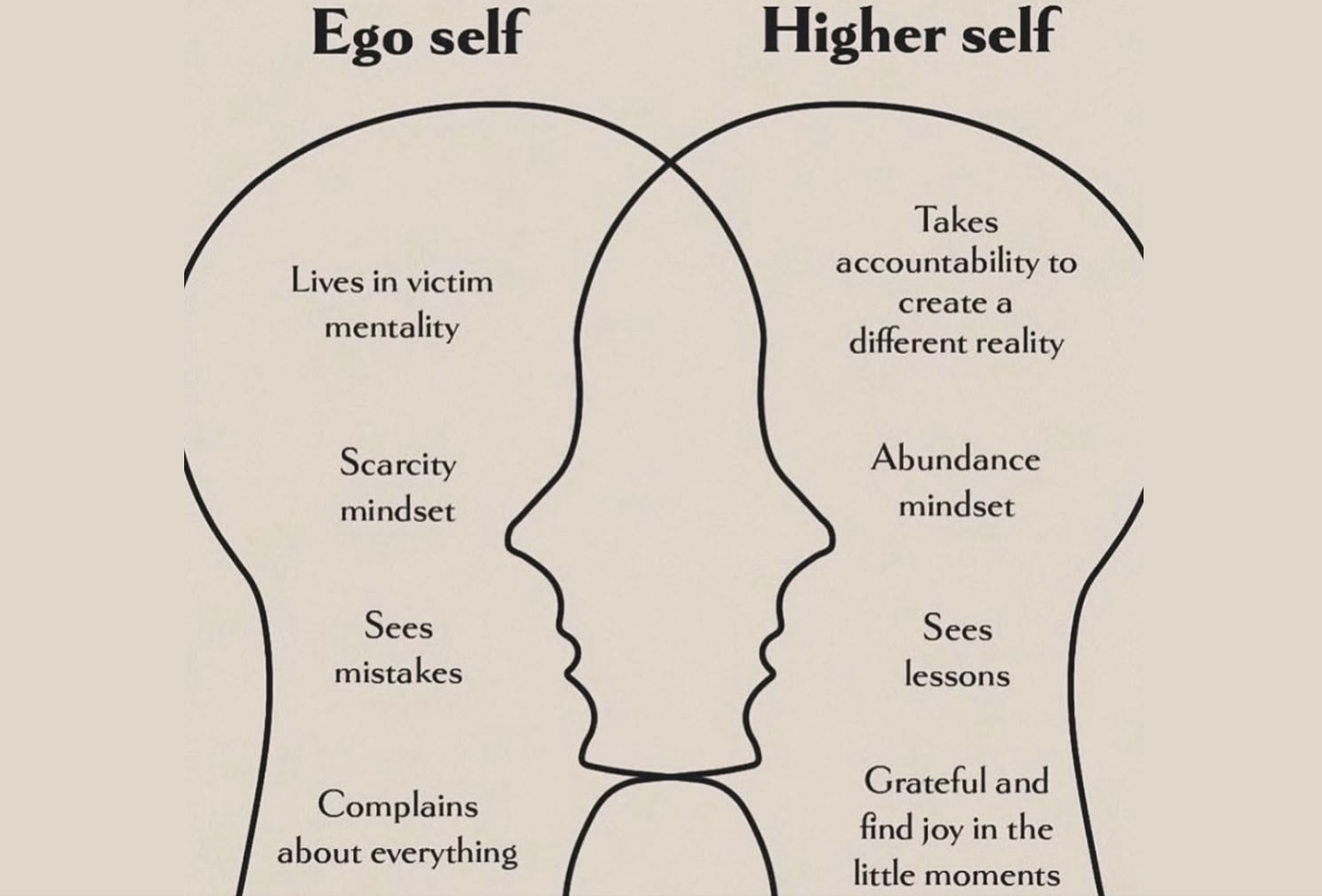
Voice of Dread vs. Voice of Higher Self
Why is my voice of dread so loud, and the voice of my higher self so quiet?
Is it actually quiet… or am I just more practiced at listening to the negative one?
I recently got a deck of cards—you pull one at random, and it offers a little insight for your day. Here’s what I picked:
Tune into your higher guide.
The voice of your higher self is positive, uplifting, and supportive.
It comes from a deeper intelligence that knows your true desires and the right path forward.
It won’t mislead you.
It asks you to take bold steps with confidence and faith.
What excites you is usually aligned with your core values and strengths.
Wait, what?
The voice of my higher self is positive, uplifting, and supportive. I love that for me. I love that for all of us.
3 a.m. Voice
We all have this internal dialogue running nonstop—in the background and the foreground. I notice mine most in the middle of the night.
At 3 a.m., the voice of dread is loud. The reason is that at this time, our amygdala is online and in charge of threat detection. Our bodies start releasing cortisol, which can wake us up. In the morning, our logical brain (prefrontal cortex) comes back online and recognizes that the amygdala was overreacting (which is its job).
I recently heard great advice from a sleep specialist:
“When you wake up in the middle of the night, your first thought will be negative, but your second thought doesn’t have to be.”
When you wake up in the middle of the night, your first thought will be negative. But your second thought doesn’t have to be…
That stuck with me.
Not just for 3 a.m., but for all the moments that feel high-stakes—like before speaking.
When I’m nervous before a talk, I can feel my focus collapse inward:
What if I forget what I want to say?
What if I don’t make sense?
What if this doesn’t land?
It’s all about me.
Here’s the shift. I remind myself: this isn’t about me.
I’m here for my listeners.
What matters is what they think and feel when they leave—not what they think about me. The moment I redirect my attention outward, something loosens.
So yes—maybe the first thought is negative. Fine.
But the second thought? That’s a choice.
Breaking the Cycle
Lately, I’ve been thinking a lot about how much time I’ve spent worrying, planning, fixing, and organizing. Trying to control outcomes.
At the same time, I’ve been listening to Anderson Cooper’s podcast All There Is, which explores grief in a really honest way. A recent guest spoke about relentless hope.
We’re surrounded by this idea of relentless hope—if you just buy the right thing, optimize enough, follow the right system, you’ll finally feel okay.
But we don’t.
Meanwhile, we’re also fed a steady stream of fear and doom. We live in this strange loop—chasing improvement while bracing for disaster.
If we really understood how limited our time is… would we spend it this way?
Our time and attention are our real currency. We give them away so easily.
To what end?
Why?
Why, oh why?
For over 30 years, my “why” has been connection.
It started in theater and improv, and it evolved into communication coaching—but the core hasn’t changed. I want people to show up as who they actually are. To say what they mean. To connect in a real way.
When one person does that, it gives permission for others to do the same.
Right now, I see the opposite happening too often. People rambling, fragmenting, and composing while speaking. Filling space instead of connecting.
Why does that matter to me?
Those are missed moments. Missed opportunities to actually reach another human being.
If you’re going to do this work—if you’re going to communicate well—you need to know your why. Your why will help you disrupt your habit pattern when it might be easier to do what you’ve always done.
“When you have a why, you can bear almost any how.” Viktor Frankl
Back to the card:
Tune into your higher guide.
The voice of your higher self is positive, uplifting, and supportive.
It comes from a deeper intelligence that knows your true desires and the right path forward.
It won’t mislead you.
It asks you to take bold steps with confidence and faith.
What excites you is usually aligned with your core values and strengths.
Before you rush back to your day, try this:
Close your eyes.
Inhale for 4.
Hold for 4.
Exhale for 4.
Hold for 4.
Repeat as needed
Then listen
That steady, supportive voice—it’s there.
It’s just easy to drown out.
For a moment, let it be the loudest one.