“An exciting game of ups and downs!”
At the end of the 2-Day Speaking Intensive, or 6 hours of 1:1 coaching, you are the best of yourself in the act of communication. You are a powerful, clear communicator OFF THE CUFF, connecting to your listeners, whether it be in your personal life or a business conversation.
Everyone sees it in their own films or in each other, and the workshop crackles with joy and inspiration.
Participants are crystal clear. “This is how I want to speak every time I open my mouth!” It doesn’t matter if it’s off the cuff or content prepared in advance; it’s all the same when it comes to great speaking.
Why oh why then do people NOT practice?
We talk all day long.
Every time we speak, it’s an opportunity to practice.
If you practiced any other skill that you chose, piano, skiing, ballet, basketball, yoga – if you did it all day long every day of your life, would you become the best you could possibly be at that skill? YES! However, only if you are practicing correctly does the repetition aid you.
What people learn at the end of the 2-day or 1:1 coaching is how to use the skill of speaking correctly and with maximum impact in every conversation. Speaking is a skill like any other skill you choose, and you can get better at it if you know what you are doing.
Why do people not practice or keep up with the amazing progress they have made? Breaking unconscious eating habits requires conscious choices. It’s the same for speaking. You are either making a conscious choice to practice correctly every time you speak, or not. This awkward, conscious practice becomes less awkward rather quickly, and then it becomes more fun.
A Game of Choice or Chance
I love working with clients regularly over time. Years ago, I taught a weekly improv class. As the current class was progressing, I would adjust my curriculum to what I thought was needed next and either pivot and do it then or note it for next week. In my mind, the learning was progressive and additive. However, this only worked if my students retained last week’s learning. I would plan a warm-up to reignite last week’s lessons, and then we could progress together.
In one ongoing class, I had a student who arrived every week as pure as the driven snow, without any memory of what we had done the previous week. He was a positive, friendly person who retained no information from one week to the next. As a coach, I felt like I was in the Bill Murray movie Groundhog Day, but it was very difficult to move the class forward as a whole when one person kept starting over.
I picture an ongoing class like the board game Candyland rather than Chutes & Ladders.
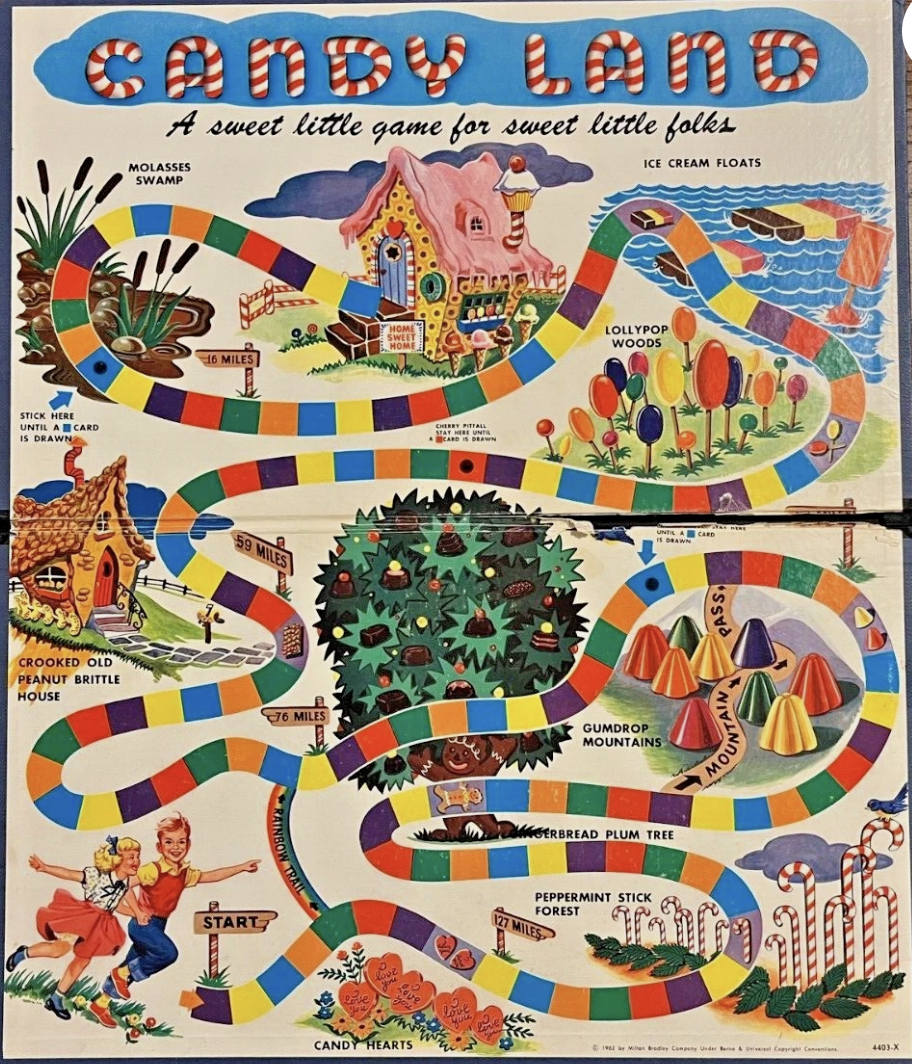
Candy Land is a simple racing board game created by Eleanor Abbott and published by Milton Bradley in 1949. The game requires no reading and minimal counting skills, making it suitable for young children. No strategy is involved as players are never required to make choices; only following directions is required.
In Candyland, you progress incrementally across the board until you reach Candyland. When I work with a client, in one session, we move them up a few spaces, or even one. Ideally, they practice, and we pick up roughly where we left off in the next session and progress again. Note the following: No strategy is involved as players are never required to make choices; only following directions is required. The problem is, real life requires the choice of intentional, thoughtful practice. Hence, working with clients can feel more like Chutes and Ladders.
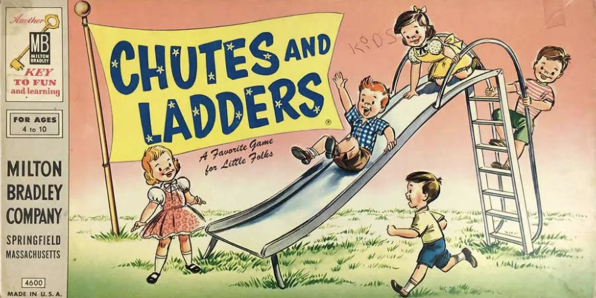
“Climb up and slide down in the exciting game of ups and downs, Chutes and Ladders! You and the character on your pawn can see the square marked 100, but it's not so easy to get there. If you land on a good deed, you can shimmy up a ladder, but land on the wrong spot and you'll shoot down a chute! Spin the spinner to see how many spots you'll move. Will your new spot send you down or move you up, up, up? Slip, slide, and see if you can win at Chutes and Ladders!”
In Chutes & Ladders, it’s a roller coaster of progress and backsliding. This may sound like real life, and that’s just the way it is, but I don’t experience that with working out and weight loss. I keep track of weights at the gym, and I lift progressively heavier over time. I know I’m stronger than I was a month ago or a year ago. I guess I'm choosing to get out of bed and go to the gym. I don’t even think about it anymore. It’s what I do.
Speaking training can be the same, incremental progress over time, but only if you practice consistently until your habit pattern becomes speaking in full sentences off the cuff most of the time.
If you aren’t progressing at the gym or in weight loss, then your next step may be to look at what you are doing through a different lens.
I started working with a trainer 8 years ago to improve my posture. It has not been about “stand up straight!” A birth defect in my hip flexors caused a whole slew of chain reactions that I am still unraveling. When I coach a client, my saying, “practice!” may not be helpful if the root cause of not practicing is much more complex. That’s where we get into the ever-interesting inner world that is unique to each person.
This part of the journey keeps me intrigued and connected to the partnership I have with every client.
To make a real change in their communication, we sometimes move into seemingly unrelated areas. The pathway is organic as we discover together what’s in the way of them practicing and improving the way they want. Their logical mind wants progress. What can we do together to identify the other parts of themselves that are sabotaging or doing things that they do not wish?
Replace Hesitation with Momentum
The brilliant Michelle Ogundehin shared these simple steps for moving something forward, and I want to share them with you now.
Sometimes we stay stuck on advancing, even on things we really want to do. It can happen due to a lack of clarity on the next move. Think about anything that hasn’t progressed forward. The first time I did this exercise, I was hesitating about which wallpaper to put on a key wall in my office/library. I knew the wall needed texture, but wallpaper (in my mind) is a big swing due to cost and effort. What if I hate it? The uncertainty kept me in limbo.
Here’s the instruction.
You have to act on it within 24 hours, thus replacing hesitation with momentum. Sit quietly and breathe evenly for 60 seconds.
Ask: What is the single next step that moves X forward?
Ask: When exactly will I do it in the next 24 hours?
Then do it and repeat the process. These tiny steps that you actually do are key to progress. Make that call, send that email, throw that thing away - whether big or small, do the next thing, then the next, etc.
It works because focusing on one step lowers overwhelm and improves follow-through. You cut out ambiguity and decision fatigue. Scheduling makes you make it happen. You have 24 hours. This is enough time, but not too long.
If too many answers come, pick the easiest one. If your answers seem vague, break them into smaller steps. Don’t forget to write it down. It’s not the same if you just keep it in your head. Act on the clearest small step in the next 24 hours.
Taking the next small step gave me energy for the next, and then the next, until the project was finished. Looking back, there were many small decisions to make, as well as some big ones, but now that part of the house is my favorite, and this progress has led me to tackle an even more complex issue.
You can apply this “one small step forward in 24 hours” to any area of your life, and the energy you will receive back can help you move other areas forward. I’ve had many clients apply this to another part of their life and then, sure enough, they figure out a way to practice great speaking throughout their day, and tangible progress comes more easily.