Getting Your Focus Back
Expand Your Tolerance for Uncertainty:
Why do I have the impulse to look at my phone if I’m waiting for anything? What did I do before the iPhone, when I was standing in line or in traffic? Why is waiting for anything so excruciating?
I stand in line to order coffee, and as soon as I am still, there is a tug to pull out my phone. I am currently disrupting this impulse. I could look around, and everyone would be looking at their phones. Waiting to board a plane, and every single person is staring at their phone. God forbid we sit there breathing. We must do something, anything, but why?
When we are taking action (looking at our phone or checking emails), making a decision, or moving through space, our nervous system reads that as influence. Influence implies control. Control implies safety. Waiting reminds you - you are not in control. (I want my coffee NOW! Let’s board the plane already!)
This gap, aka waiting, is what generates agitation, which is why I feel the urge to look at my phone. My predictive brain cannot close the loop. Uncertainty activates my ancient threat circuitry. It keeps scanning, causing me to feel a need to do something, and the only thing I can do in that moment is compulsively check something (my phone).
Connecting this to my post on over-functioning, it can feel much better to keep doing and moving rather than sitting in uncertainty. I know I would rather use Waze and weave through the city than sit still in traffic. A feeling of claustrophobia comes over me, and I feel I must DO something. In my head, if things are moving forward, my nervous system interprets that movement as a sign of being more in control. I am gaining agency because I’m doing something. My brain releases dopamine in response, and I feel better.
A question to ask myself. Is my sense of safety internal or outsourced to productivity? My answer is usually “outsourced to productivity.” My challenge, then, is to increase my capacity to remain calm (not agitated) without doing anything. To sit, and be, and notice, and breathe, and feel the tug to check my phone, and not do it, and breathe again, and notice something in the space I’m in, and feel the impulse to grab my phone, and don’t grab the phone, and sit and breathe and be. Talk about agency!
How to Practice from Michelle Ogundehin:
Shrink what you’re trying to control: Instead of trying to control the outcome, focus on your immediate space. Small, simple actions create a sense of order, and that sends a signal to your body that you’re capable and okay.
Put boundaries around the waiting: Choose a specific time to check, not constantly and not on impulse. Something like, “I’ll check again at 3 PM.” This helps stop the mental spiral and gives your mind a clear limit.
Come back to your senses: Pay attention to what’s physically around you. The feeling of the chair under you. The sounds in the room. The temperature of your hands. Grounding yourself in your senses reminds your nervous system that, in this moment, you’re safe.
Use the restless energy: Waiting builds up energy, so move it somewhere. Go for a walk, clean, or organize. Not to avoid the feeling, but to work with it. Your body is looking for an outlet.
See waiting as practice: Every time something is unresolved, it’s a chance to build your tolerance for uncertainty. It’s not passive — it’s actually a form of strength. Being able to stay calm without having answers yet is its own kind of power.
I’m already pretty solid with the first four — they come naturally to me. The fifth one is what I’m really working on right now. Just noticing the urge to check my phone while I’m waiting, and choosing not to act on it. Sitting with it, breathing, just being. There’s something really powerful about realizing I have a choice, instead of running on autopilot.
“Too Far From Source”
A few nights ago, as I was falling asleep, I asked myself, “Why am I always tight even when I try to relax?” I stretch, meditate, take baths, and even my physiologist has noticed that my body is always on alert.
That night, I had a dream that I was trying to charge my phone, and it wouldn’t charge. An error message came across the screen: “too far from source.”
I’ve taken this message to heart. My subconscious mind suggested that my physical tension might stem from trying to recharge without being fully plugged into what truly restores me.
When we are constantly busy, solving problems, or pushing ourselves, we can drift away from the part of ourselves that actually generates energy and calm.
What actually restores me? I am currently on a quest to figure this out.
My first impulse was to immerse myself in nature. However, over the last few years, when in nature, I have struggled to feel connected to it and have been unable to be fully in awe.
I was teaching a workshop at Cornell, in Ithaca, New York, famous for having 150 waterfalls within 10 miles. I went on a walk and saw waterfalls, but couldn’t feel them. Almost as if it were a checkmark, Waterfall. Check! Another waterfall. Check! Pretty tree. Check!
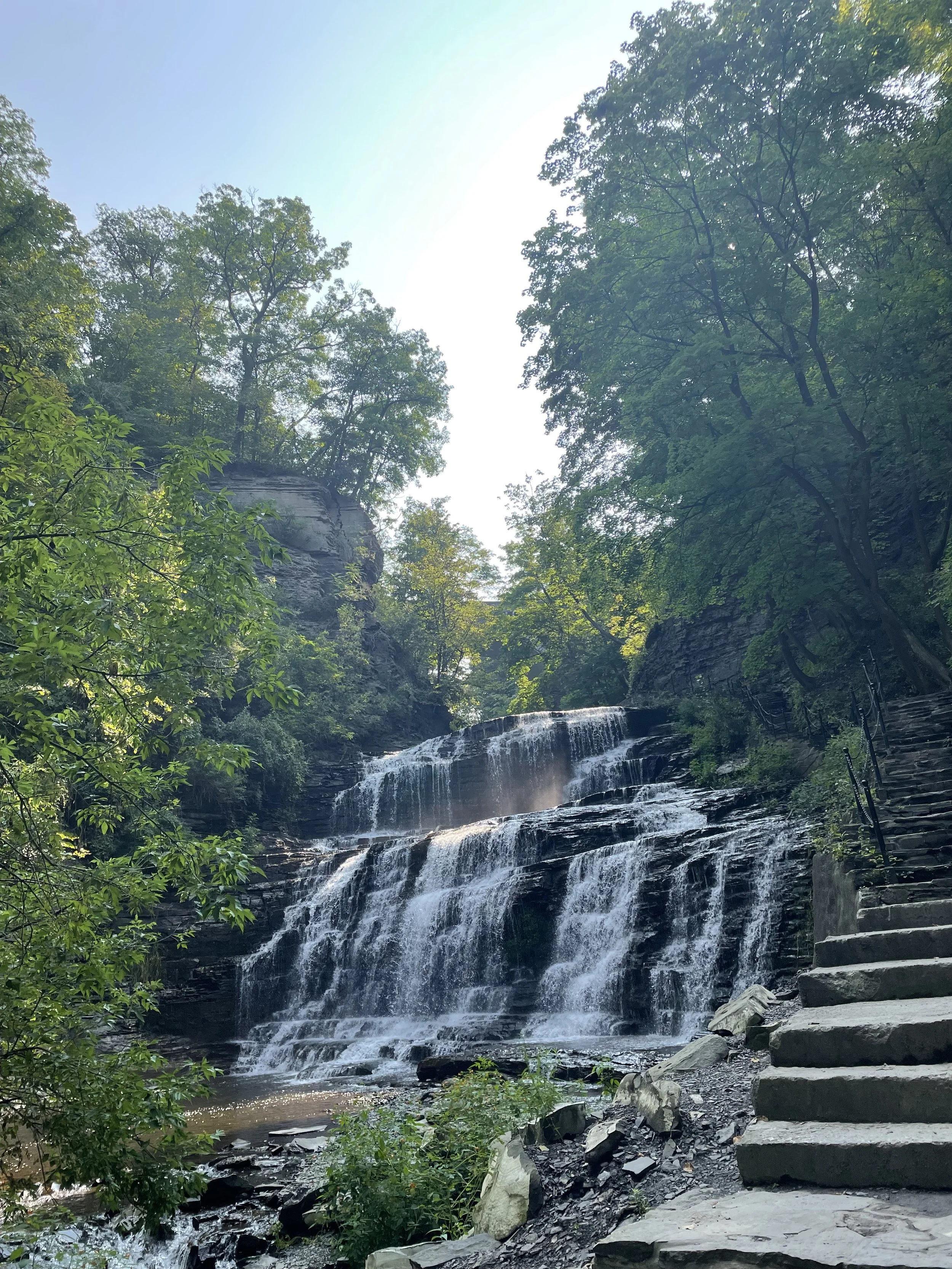
After the waterfalls, in a crazy rainstorm, I drove to Binghamton, New York, to see Rod Serling’s (creator of The Twilight Zone) childhood home. Mentors Home. Check!

It bothers me that I drove all the way there and couldn’t absorb it. I always thought I would drive there if I were ever in this part of New York. I kept my word to myself. I still responded to the adventure as if it were nothing. Just crossed off something on my to-do list.
It could be that nature would restore me if I stayed in it longer. One theory I have is that I’m usually on a schedule and don’t spend enough time in nature to let it regulate me. I’m usually hiking through it, or pausing to take a picture of it - am I engaging with it? My gut says that I need more time to unwind. This rings true, which is why I am tenaciously choosing NOT TO PICK UP MY PHONE.
Carl Jung saw dreams as messages from the unconscious trying to rebalance the psyche. Jung believed that when the psyche is too far from its natural center, the body reacts. Many people with chronically tense nervous systems relax more when they’re in forests, oceans, mountains, and wide natural landscapes, because the body recognizes those environments as evolutionary safety zones.
Tonight or during quiet time, you might ask yourself:
Where do I actually feel closest to Source in my life?
When do I feel the most grounded or alive?
What environments soften my body naturally?
Those moments are often clues to where your psyche plugs into its energy source.
Relaxing the Body and Helping Your Mind Relax:
The body has two major modes:
Sympathetic nervous system → alert, defensive, tense
Parasympathetic nervous system → rest, digest, relax
If your body learned at some point that it needed to stay on alert, it can get stuck in that state. Even if you stretch, meditate, take baths, or work out, your nervous system might still default to “stay ready.”
The tension can show up as constantly tight shoulders, a clenched jaw, shallow breathing, or just not really knowing what it feels like to be fully relaxed — maybe not being able to recall ever having felt that way at all.
That’s where retraining the nervous system comes in. Things like somatic therapy, breathwork, vagus nerve work, and other body-based practices can really help. They work from the body up, not just from the mind down.
Before bed, try this:
Lie down and put one hand on your chest and one on your belly.
Slowly inhale through the nose for 4 seconds.
Exhale slowly for 6–8 seconds.
While exhaling, mentally say: “It’s safe to soften.”
Longer exhales signal the parasympathetic system to turn on.
Just 5 minutes can help your body learn it’s okay to let go little by little.
If your body has been tense for years, it often doesn’t release all at once. The nervous system tends to unwind gradually, sometimes in layers.
RITUAL
Rituals are small, steady behaviors that create a sense of safety, rhythm, and presence. They help your nervous system settle, and your mind focus.
Some wisdom from James Clear, author of Atomic Habits: An Easy and Proven Way to Build Good Habits and Break Bad Ones: “In the long run (and often in the short run), your willpower will never beat your environment. The more disciplined your environment, the less disciplined you need to be.” Can you turn off notifications sometimes and give yourself a shot at staying focused?
My environment is very organized; for me, my ritual and discipline are about putting my phone away, disconnecting from that world, and connecting to the world my body is in. Really figuring out when I need it, and when I don’t. I love my old school watch, and I make phone appointments with friends so we can catch up via phone or in-person - not through social media.
I would love to hear from you. What are you currently practicing that helps you feel more in the present moment?
Until next time,
Jo